

Yesteryear and the Performance of Perfection
The Book Report Volume 16: On the Hype Shelf


I’m not too “serious” about literature to admit that I genuinely enjoyed the buzziest book of the year, Yesteryear by Caro Claire Burke. The premise alone is genius: a sanctimonious “tradwife” influencer, Natalie Heller Mills, (think, a brunette Ballerina Farm) suddenly finds herself transported to the 1850s, stripped of the modern conveniences she pretends she doesn’t need: nannies, electricity, refrigeration, medicine, pesticides…
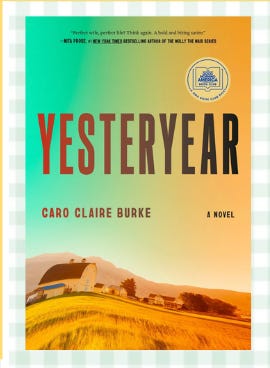
I wasn’t expecting to like this book. I assumed it would be a shallow depiction of Instagram influencers, and initially, that’s how I experienced it, as glossy, escapist pop fiction. Not bad, but just not the usual intellectual depth that I tend to gravitate towards.
Based on what I’d read about the book, I was expecting a satirical cultural critique of social media, the religious right, and prescribed gender roles. Instead, what I experienced was a critique of women in general. The female characters were trapped in narrow archetypes — angry career women or self-righteous martyr mothers — predictable, one-dimensional and pretty soulless. Usually, I need a likable narrator to enjoy a book. Natalie isn’t likable, but she is compelling. I think we’re meant to take pleasure in watching her unravel, which only served to confirm my suspicion that the novel was missing the mark.
But as I kept reading, I found more empathy — seeing Natalie not as someone to despise, but as someone to understand. My first impressions were wrong. Or, if not wrong, at least incomplete.
What I initially understood as a critique of bad Instagram mothers and women in general gradually revealed itself to be something deeper: a critique not of the women, necessarily, but of a culture that imposes impossible standards for women, regardless of which role they choose to inhabit.
If anything, the major weakness of the novel is that Burke didn’t go deeper into Natalie’s psyche. The ending* feels rushed, missing an opportunity to explore Natalie’s contradictions, desperation, and motivations. In the end, we understand the “what” but not necessarily the “how” or the “why.” Natalie gains dimension, but not enough.
Overall, the book surprised me, in a great way. Burke taps into our fascination with tradwife influencers and curated sourdough-starter domesticity, while also offering us a broad exploration of womanhood as performance. She manages to write something that is both popular and smart, escapist and emotionally layered. And that’s the real brilliance of Yesteryear: it succeeds because of its contradictions. Or maybe we all just love to watch the trainwreck of an unhinged mother…
*Don’t worry, no spoilers, but you may have heard that Anne Hathaway bought the rights to the book and will star in the movie version, but what I didn’t know is that, according to Books and Bits, “Burke has said that while she was writing the book, Anne Hathaway bought it, and then Hathaway helped her finish it.” Does anyone else find this odd? I’ve written before about the movie-fication of literature. I just, naively perhaps, did not know this was something that authors were doing. I’d be very curious to know Burke’s initial plans for the ending and the influence of Anne Hathaway.
Great review! Having just finished the book, I agree that the wrap-up was a bit rushed. I wanted a better picture of the mental spiral, is all I can say without giving spoilers.