

Recent Reads: January 2026
Shortlist Volume 17


I’m trying something new here, reviewing everything I read this month, including some new releases, backlist bestsellers and future classics.
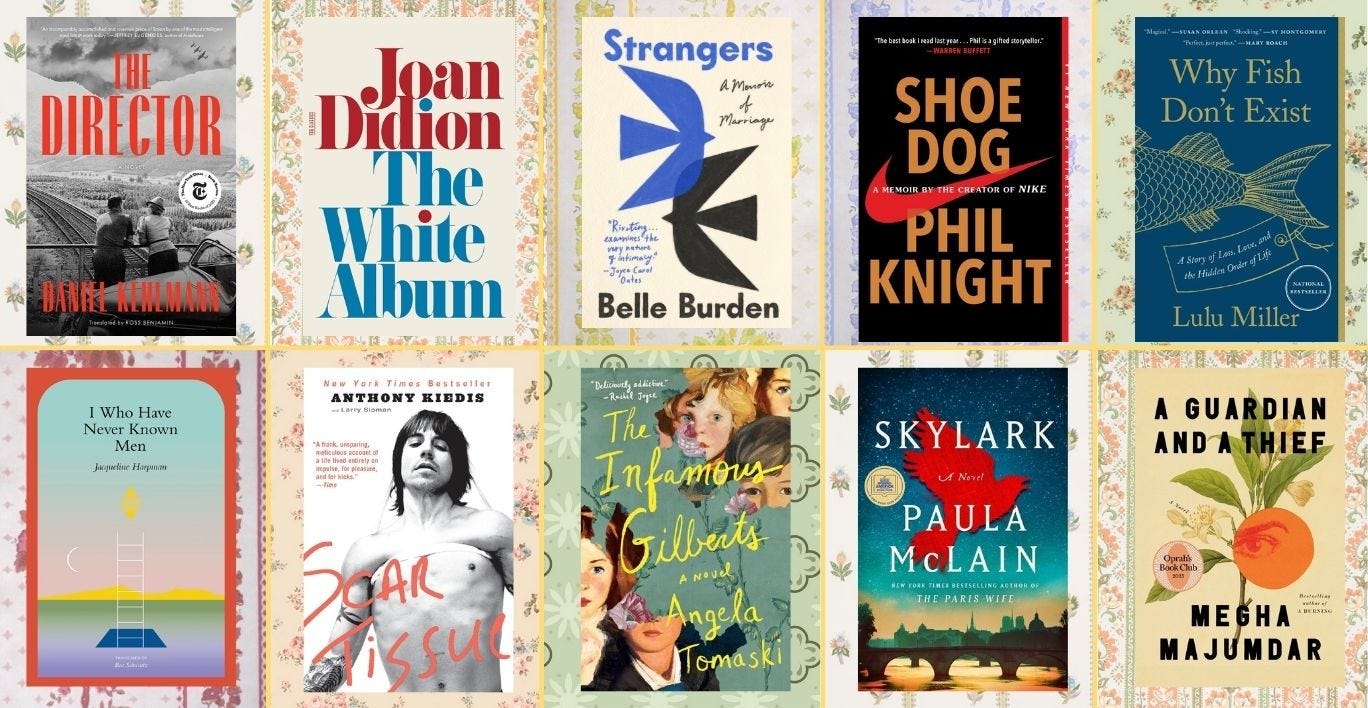

The Director by Daniel Kehlmann, translated by Ross Benjamin. Bold and brilliant, this novel, about the Austrian film director G.W. Pabst who worked under Joseph Goebbels’ Ministry of Propaganda, explores the moral grey area of complicity. Historical fiction, but with surrealist and even comic moments, the book can feel nightmarish, but it’s cinematic and glorious in its execution. A must-read. (My full Book Report here).

The White Album by Joan Didion. Part autobiography, part critique, this compilation of essays about the fragmented cultural landscape of America in the 1960s has become required reading for all the smart, cool girls. The White Album by the Beatles serves as the book’s metaphorical thread, connecting a decade marked by anarchy and assassins, the women’s movement and Vietnam, free love and folk and funk, racism and rallies and religious fanatics. Like the album, and the era Didion examines, her essays can feel discordant or chaotic, not flowing in any logical sequence. She jumps from a recording session with Jim Morrison to the Manson murders to a multiple sclerosis diagnosis. Yet, like everything Didion writes, its structure holds, pages filled with her deeply intelligent observations, every word intentional.
Strangers by Belle Burden. What began as a NYT Modern Love essay about infidelity evolved into a tender tell-all about the dissolution of marriage and all the things that make up a shared life - family and friends, careers and kids, money and legacy. It’s as much a meditation on marriage as it is a deeply moving reflection of the bonds between mothers and daughters and how women hold each other up when everything else feels fragile and uncertain. I thought, I don’t need another angry, man-hating memoir. Luckily, I found something very different.
Shoe Dog by Phil Knight. Inspiring, nostalgic, heartfelt, sentimental, spiritual even, Phil Knight’s memoir about the early days of Nike lives us to its hype. Offering life and business lessons along the way, Knight chronicles the challenges, risks, scandals and sacrifices that come with building a company from the ground up. It’s not exactly a rags to riches story (Knight went to Stanford Business School), but his success cannot be overstated: he turned a $50 loan from his father in 1962 to $45B in revenue in 2025, making him one of the richest people in the world. From his writing, you wouldn’t know it. Knight comes off as humble and collaborative, making it clear that it’s the people, the loyalists from the brand’s earliest days, that propelled Nike beyond any of their wildest dreams.
Why Fish Don’t Exist: A Story of Loss, Love, and the Hidden Order of Life by Lulu Miller. Is it biography, memoir, history, psychology, popular science, philosophy? Yes. The underlying thread, the glue that binds the otherwise fragmented narratives, is a quest to make order in a world ruled by chaos. About the taxonomist and academic David Starr Jordan, who discovered a significant number of fish species, it’s weird and winding, but also a quick read. What begins as a book about fish classification segways into psychology, pivots to a juicy murder, and then tackles evolution and eugenics, taking us into dark hidden corners of our country’s history. The author interjects her own story into the narrative, offering personal anecdotes, asking her own unanswerable questions (when other writers simply would not have asked). I liked her casual voice, her vulnerability, her accessibility, but what I liked most is that she allowed herself to be wrong, to be contradicted, to be open. She writes, “The true path to progress is paved not with certainty, but doubt, with being ‘open to revision.’” One minor issue, if I’m being picky, is that, while I felt like I was on this journey with the author the entire time, a quick Google search of her hero would have revealed what she takes the entirety of the book to unveil. Either way, the message prevails. Humans get things wrong, what appears to be one thing turns out to be another, what we think is right might actually be wrong, and on it goes. In a closed off world, just the idea of not only being open to accepting that we got things wrong, but actually admitting it, is an act of courage.

I Who Have Never Known Men by Jacqueline Harpman, translated by Ros Schwartz. Originally published in the 90s, this novel, about a group of captive women and their quest for freedom, saw a huge resurgence of popularity in 2025 (you probably saw it on a lot of the year-end lists). It’s a meditation on solitude and community and on coming of age without constructs. I’d try to categorize it as philosophical, post-apocalyptic, psychological dystopia (say that five times fast). Or, if you like Emily St. John Mandel, Margaret Atwood, Kazuo Ishiguro, don’t skip this one.
Scar Tissue by Anthony Kiedis. Like the Red Hot Chili Peppers front man himself, this memoir is a crazy, energetic, wild ride. Full of casual sex, rampant drug use, and some rock and roll, Kiedis leaves it all on the table, including details of his jaw-dropping childhood, the 1970s LA punk club scene, his rise to fame alongside his gang of misfit egomaniacs, his battles with heroin addiction and his very robust dating life. Kiedis writes without animosity or resentment, and what the book lacks in introspection it more than makes up for in entertainment. Even if he’s not very likable, his life, like this book, is totally fascinating.
The Infamous Gilberts by Angela Tomaski. An eccentric, darkly comic, dysfunctional family drama, marketed as Kazuo Ishiguro meets Wes Anderson. I suppose I can see a loose connection to The Remains of the Day (setting, narrator, era) and The Royal Tenenbaums (wacky sibling relationships), but marketing aside, it’s one of the most creative books I’ve read recently and kept my attention throughout. The Gilbert family’s story is narrated as a tour of their run-down English manor, in a quirky, second-person conversational voice that you’ll either love or hate, like “See them there in Aunt Beatrice’s room - the one with the apricot-coloured walls and the walnut four-poster bed - as Lizzie brushes Annabel’s hair.” And,“she is a diarist largely of the ‘Tuesday: dentist, fish for dinner’ type.” For me, the writing style is the book’s greatest strength. The tradeoff is that, while heavy on style, it can feel light on substance, and even in the book’s darkest moments, I felt a sense of distance from the characters. At times, particularly in the beginning, the story felt choppy. I do think this would make such a great show - visual setting, clever writing, rich people behaving badly, that sort of thing. I never say this, but I wondered if the book might be better on audio, since the voice is such a strong point, so I listened to part of it and it’s solid. Overall, a really impressive debut (sidenote, love the author’s bio) and I’m excited to see what she does next.
Skylark by Paula McLain. With propulsive, movie-worthy momentum and richly descriptive prose, this hopeful historical fiction novel follows parallel survival journeys, 300 years apart. Kristof, a psychiatric doctor in 1940s occupied Paris, becomes part of the French Resistance to help his patients and Jewish neighbors. Alouette, a late 17th century French fabric dyer, finds herself wrongly imprisoned in Salpêtrière, a female psychiatric hospital. Fueled by their fragile courage, their loyalty to the people they love and a commitment to their work, the book follows their paths of resistance.

A Guardian and a Thief by Megha Majumdar. A Kolkata family plans to emigrate to the United States as the situation in their hometown grows desperate, but all hope is shattered when someone interferes with their plans. There are echoes of Prophet Song (set in the near future, a foreign country in chaos, a desperate mother trying to get her children out of said country, an absent father), but Majumdar’s version is less intense and more infuriating. And don’t even get me started on the improbable and ridiculous coincidence that two of the main characters meet their fate in the exact same way. Plots that revolve around endless trials, blackmail and misunderstandings are not my favorite, although they do tend to have good momentum and make for a solid book club pick (See: Oprah).