

My Top 10 Fall Reads
The Shortlist Volume 13


In preparation for The Book Reporter grand finale in two weeks, the full-year best of the best, below you’ll find my Q4 favorites, featuring some very good fiction writing and some excellent nonfiction. In the spirit of giving, I’m not going to paywall this one, so tell your friends :)
You can also read My Top 25 of 2025 - First Half here and My Top 10 of Q3 here.
Share in the comments what you read and loved (or didn’t)!
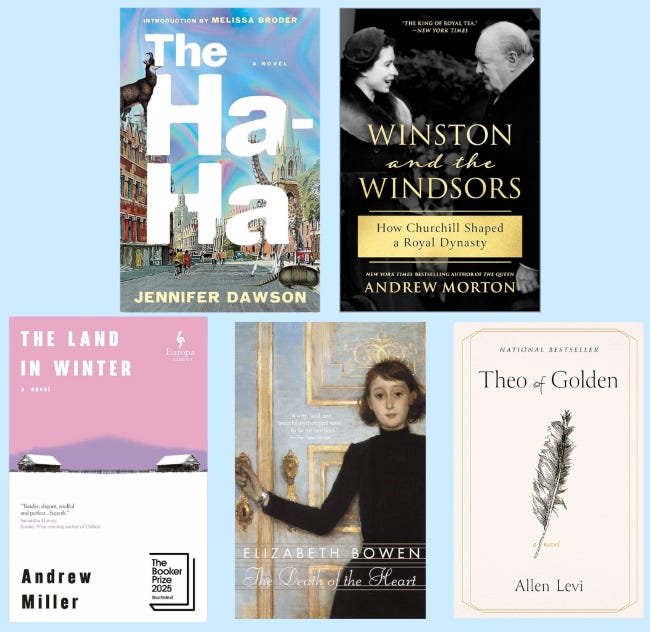

The Ha-Ha by Jennifer Dawson. A reissue of the critically acclaimed 1961 semi-autobiographical debut, this coming-of-age novel follows a young woman grappling with a desire to belong, to fit in, to feel normal, and to understand social codes made even more elusive by her schizophrenia diagnosis. In a modern technological world where reality is constantly in question, Dawson urges us to consider a more intellectual, existential form of “reality.” With a focus on a young woman’s experience with mental illness in mid-century and its introspective, poetic tone, this book has been likened to Sylvia Plath’s The Bell Jar. In a recent NYT op-ed, Gerald Howard writes that “the trend of the moment in literary publishing is backward-looking, as a clutch of new imprints scour dusty backlists and long out-of-print books for titles whose time has finally arrived.” I hope The Ha-Ha gets her time in the sun.
Winston and the Windsors: How Churchill Shaped a Royal Dynasty by Andrew Morton. Overall, this take on Winston Churchill and his lifelong relationship with the royal family is entertaining and informative. Morton’s storytelling is at its best when he shares the lesser known stories that humanize these legends (like the family drama surrounding Elizabeth II’s abrupt and unexpected ascension from obedient teen to monarch). I was completely engrossed by the page-turning coverage of WWII, the tension around King Edward VIII’s abdication, and the fascinating history of the PM’s childhood and his ancestors. It’s notable that Churchill’s wife and children are mere footnotes here (the death of his two-year-old daughter is mentioned in passing, given only a partial sentence; his wife, Clementine, is only a minor character), presumably because his family of origin was more impactful in terms of establishing and maintaining the royal connection. And, to be fair, Morton isn’t writing about Winston and his wife – this is a book about Winston and the Windsors. And so it is that I would round up from 3.75 stars and recommend to anyone who has an interest in Churchill, British history, the royals and fans of The Crown.
The Land in Winter by Andrew Miller. Another 3.75 rounded up because the writing is really, really skillful. This atmospheric novel, about two married couples in the 1960s English countryside, is detailed and highly descriptive, but moved a bit too slow. The nuanced writing, the psychological exploration, and even the characters echoed Revolutionary Road for me, but ultimately, it wasn’t up to Yates’ caliber. I had a lot of starts and stops with this one, but by about 40% (thanks to my new Kindle for tracking), I was able to not only appreciate it, but enjoy it. Overall, a solid winter read, but not if you’re looking for a fast-paced plot.
The Death of the Heart by Elizabeth Bowen. I understand why this 1930s coming-of-age classic - about a teenage orphan who goes to live with her upper-class brother and sister-in-law in London - ends up on so many 20th century best literature lists. Bowen’s writing is artistic and complex while feeling effortless. I enjoyed the imperfect characters, the unresolved conflict, the poetic dialogue, and the emotional depth. Despite all of the obvious strengths of this book, I wasn’t always excited to pick it up. At times, I needed a little more momentum to stay connected. Portia, the main character, sometimes felt flat when compared to her larger than life sister-in-law and her love interest (who, for his self-serving, flippant charm, I kept imagining as Oscar van Rhij from The Gilded Age). But it has stayed with me, which is, perhaps, the genius of Bowen’s writing. I think about this book a lot, and the more distance I have from this one, the more I appreciate it… I actually want to read it again soon, ideally with a glass of wine in front of the fire.
Theo of Golden by Allen Levi. A wholesome, feel-good novel about an old man who moves to a small town in Georgia and begins gifting people portraits drawn by a local artist. Self-published in 2023, this beloved debut about faith and generosity sold 150,000 copies through word-of-mouth alone before being acquired by Simon & Schuster (recently released as an audiobook).

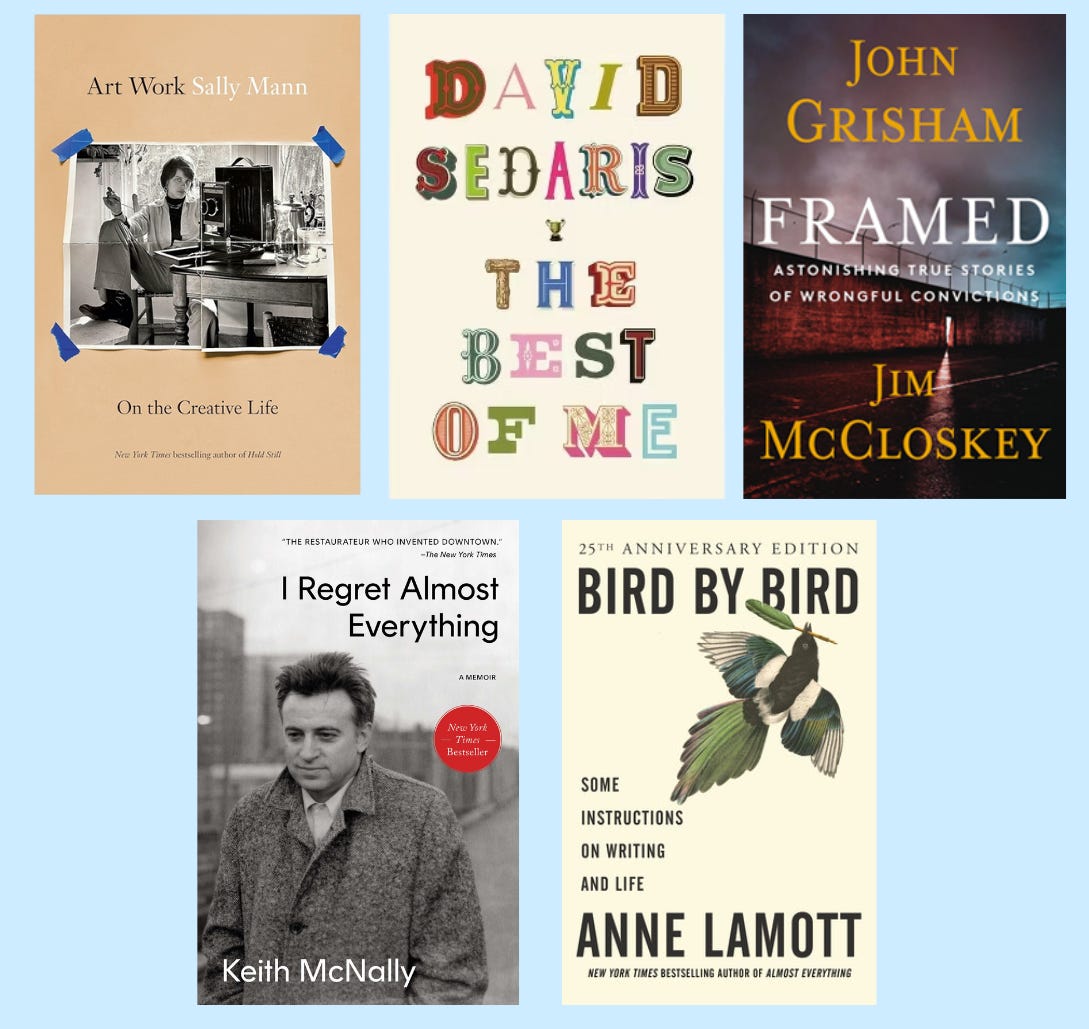
Framed: Astonishing True Stories of Wrongful Convictions by John Grisham and Jim McCloskey. Ten true stories of nightmarish wrongful convictions, written by John Grisham, the unrivaled master of legal thrillers, and Jim McCloskey, the founder of the exoneration nonprofit Centurion Ministries. Each chapter dives into a specific case riddled with injustice, negligence, misconduct, incompetence, and corruption, and the ensuing battle for justice. For anyone who has ever doubted or questioned the plausibility of a false confession, just start with the first case. This collection is not for the faint of heart - there are, of course, no happy endings, only shattered lives - but there are glimmers of hope, too.
Art Work: On the Creative Life by Sally Mann. Essential reading for anyone in a creative field, artist Sally Mann reflects on a long career, including recurrent rejection, the challenges and joys of motherhood while making art, and the importance of luck and friendship. It’s original, it’s honest, and it’s beautiful, enhanced by her photos and correspondence throughout.
The Best of Me by David Sedaris. A compilation of social humor essayist David Sedaris’ most hilarious stories. If you read only one of his books, read this one. That said, if you’ve recently read his other books, you might consider skipping this one, since there are a lot of repeats. Personally, I enjoyed revisiting them (especially “The Incomplete Quad,” “Me Talk Pretty One Day,” and the one about Mrs Peacock, the overnight babysitter) and I laughed just as hard the second time.
I Regret Almost Everything by Keith McNally. More than just a memoir for New Yorkers and foodies, this is an honest look back at the restauranter’s successes and failures, love, family, and yes, regret. From his working class roots to his foray into acting to the opening of The Odeon, Balthazar, and Minetta Tavern, McNally bares it all in this nostalgic trip down memory lane, sharing everything from Jon Belushi’s partying and Patti Smith’s bad manners to McNally’s own struggles with mental health after a stroke. Unpretentious, self-deprecating, and curious, he comes off as something of a Renaissance man, always searching for beauty and art in unexpected places. I especially enjoyed his musings on reading the classics. After weeks of seeing this book at the top of McNally Jackson’s bestseller lists, I finally picked it up at the urging of my well-read neighbor (thank you, Madeline!). I’m so glad I did.
Bird by Bird: Some Instructions on Writing and Life by Anne Lamott. Smart, funny, inspiring and introspective, this bestseller is more than thirty years old. The author teaches a writing course and the title promises writing instruction, but I wouldn’t describe it as a technical how-to-write-fiction guide. It’s more writing memoir: a reflection of Lamott’s personal journey including her process, growth and struggles, what’s been helpful to her and what hasn’t, and the things she read and saw and experienced that inspired, motivated, encouraged, validated or helped her in her career. She uses her remarkable storytelling skill to share the joys, challenges, anxieties, fears, and self-doubt that come with the job title of “writer.” Full of humorous metaphors, self-deprecating wit, and warm-hearted stories, this book will make you laugh, smile, and feel - whether or not you’re an aspiring writer.
**As always, if you shop through my links, I might earn a commision**